
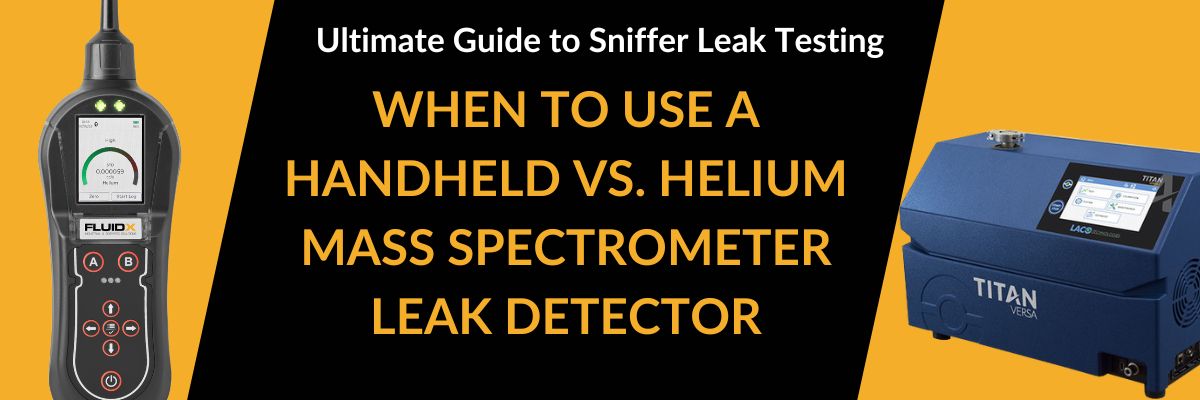
Sniffer leak testing is one of the most widely used tracer gas test methods for locating and measuring leaks in pressurized or sealed systems. From quick maintenance checks to controlled validation testing on a production line, the right tool depends on your sensitivity requirements, tracer gas, test environment, and workflow. In this guide, we break down sniffer leak testing basics and compare portable handheld leak detectors available from LACO Technologies' FluidX brand with helium mass spectrometer leak detectors, such as the TITAN VERSA, available directly from LACO.
Sniffer Leak Testing Basics
Sniffer leak testing is a tracer gas method where a component or system is pressurized with a test gas and a probe is used to “sniff” around joints, seals, welds, and potential leak points. When tracer gas escapes, the detector senses it and alerts the operator.
Common tracer gases include
- Helium – inert, widely used for high-sensitivity applications
- Hydrogen (often in a safe forming gas blend of 95% nitrogen) – less sensitive compared to helium, but often more cost-effective
- SF₆ – traditionally used in some electrical and utility applications
- Other Gases – many systems contain or process other gases such as Argon, CO2, methane, etc.
Sniffer testing is popular because it
- Locates the physical position of leaks quickly
- Can quantify the size of the leak
- Eliminates the need for chemicals and hassles associated with bubble testing
- Works well on components or assembled systems
- Supports both troubleshooting and in-process inspections
Portable Handheld Leak Detectors for Sniffer Testing
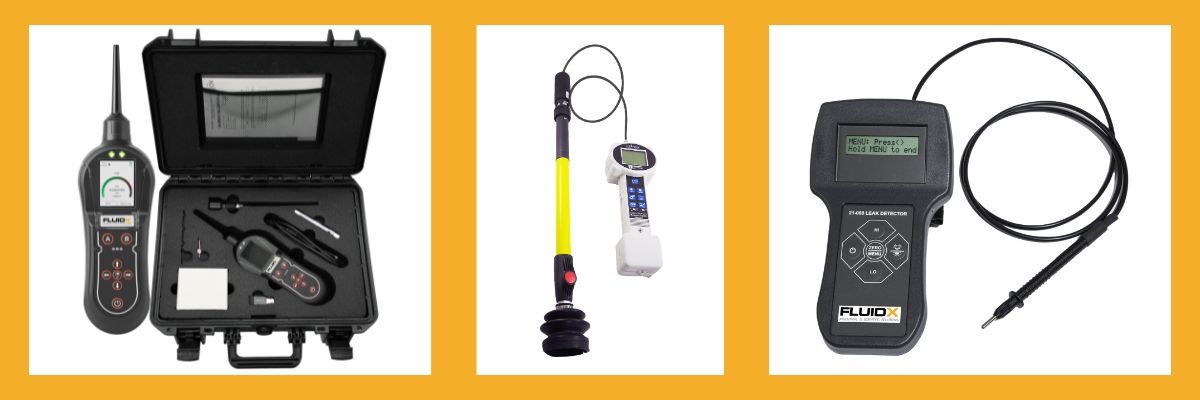
Portable handheld leak detectors are designed for mobility, speed, and ease of use. These battery-powered instruments allow technicians to move freely around equipment and quickly pinpoint leak locations. This guide will focus on handheld leak detectors that use thermal conductivity sensors for gas detection.
Typical characteristics
- Lightweight, handheld operation
- Can detect a wide range of tracer gases
- Fast warm-up and quick response
- Ideal for maintenance, lab use, and field service
- Well suited for installed equipment and tight or hard-to-reach spaces
Additional use case
Some handheld detectors can also be used for underground leak detection when paired with probe accessories, making them useful for utilities and buried line inspections.
Sensor technology
Most multipurpose handheld leak detectors use thermal conductivity detection (TCD).
Thermal conductivity sensors measure how efficiently a gas transfers heat compared to a reference gas (typically air). For example, Helium and hydrogen have much higher thermal conductivity than air, so when tracer gas is present, heat is carried away from the sensor element more quickly. This change in heat transfer alters the sensor’s electrical characteristics, which is converted into a signal.
How it works
- A heated sensor element is maintained at a controlled temperature
- Sample gas is sucked through the sniffer probe, flows over the element
- Higher or lower thermal conductivity gases compared to air (the reference gas) remove heat at different rates
- The resulting sensor temperature change produces a measurable electrical response that corresponds to the concentration of the gas in the sample
Implications
- Responds to tracer gas thermal conductivity, not atomic mass
- Indicates presence and relative concentration of tracer gas
- Does NOT indicate what gas is present (the tracer gas used should be known and is often entered as a parameter into the leak detector)
- Well suited for leak location and comparative measurements, not for precise leak rate measurements
- Detection limits are higher (less sensitivity) than mass spectrometer systems
- Sensitivity and stability can be impacted in environments where the surrounding reference environment (reference air) contains high humidity or common gases such as CO2
- Sensor response can vary with temperature, flow conditions, and background gas composition
Why TCD works well in handheld instruments
- Compact and low power
- Fast response time for sweeping surfaces
- Mechanically simple and rugged
- Cost-effective compared to mass spectrometer systems
Handheld leak detectors using thermal conductivity sensors excel at answering:
“Is tracer gas present here, and where is the leak?”
They are not designed to provide highly accurate and sensitive or standardized leak rate measurements.
Mass Spectrometer Leak Detectors for Sniffer Leak Testing
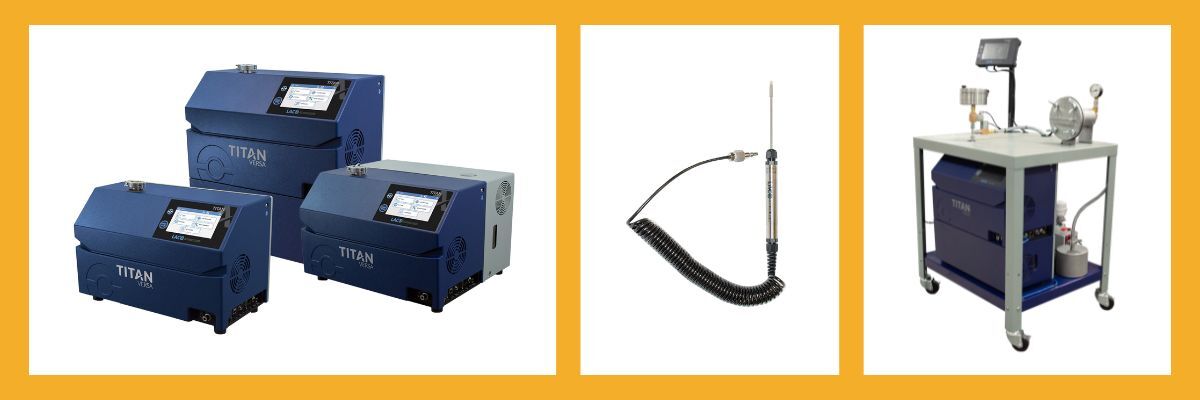
Mass spectrometer leak detectors like LACO's TITAN VERSA support both sniffer and vacuum leak testing and are designed for applications where higher sensitivity, stability, and repeatability are required.
Typical characteristics
- Fixed or cart-mounted system with sniffer probe and hose attached
- Higher sensitivity than handheld sniffers
- Common in R&D, validation, and production test stations
Sensor technology (key difference)
Mass spectrometer leak detectors use a mass spectrometer as their sensing core. Instead of relying on bulk gas properties, the system directly identifies and measures the tracer gas molecules by atomic mass properties. The mass spectrometer is capable of measuring helium (4), helium isotope (3), or hydrogen (2).
How it works
- Incoming gas from the sniffer probe is directed to the analyzer cell, where it is ionized by electron bombardment
- Ions are separated or filtered by their mass-to-charge ratio using electromagnetic fields
- Only ions corresponding to the selected tracer gas (e.g., helium or hydrogen) are detected
- The selected gas ions are measured directly as electrical current as they impinge upon the detector
This allows the system to isolate tracer gas from background gases with extremely high selectivity.
Implications
- Direct identification of tracer gas by atomic mass with no interference of other gas species
- Very high selectivity and sensitivity
- Capable of detecting extremely small concentrations of tracer gas
- Quantitative leak rate measurement due to high sensitivity, stability, and proportional output of the mass spectrometer
- High stability and repeatability for controlled testing
Mass spectrometry answers:
“How much tracer gas is leaking, and does it meet specification?”
Not just where the leak is located.
Key Differences: Portable Handheld Leak Detectors vs. Helium Mass Spectrometer Leak Detectors
| Area of Comparison | Portable Handheld Leak Detectors | Helium Mass Spectrometer Leak Detectors |
| Mobility | Fully portable | Fixed or cart-mounted with hose and sniffer probe |
| Primary Strength | Speed and flexibility | Sensitivity and gas selectivity |
| Typical Use | Field troubleshooting, maintenance | Validation, R&D, production testing |
| Tracer Gas | Any gas with different thermal conductivity compared to air | Helium, Helium (3), Hydrogen |
| Sensor Technology | Thermal conductivity | Mass spectrometer |
| Sensitivity Range | Moderate | Very high |
| Measurement Type | Relative presence | Quantitative leak rate |
| Price | Lower ($2,000 - $10,000) | Higher ($20,000 - $30,000) |
Choosing the Right Tool
Portable handheld leak detectors are often the better choice when:
- Performing maintenance and troubleshooting on installed equipment
- Locating leaks in tight or hard-to-access areas
- The tracer gas is not helium or hydrogen
- Conducting production floor spot checks or in-process inspections
- Supporting field service and mobile testing
- Leak location when there is already a known leak
- Finding the leak location matters more than ultra-high sensitivity
Helium Mass Spectrometer Leak Detectors are typically the better fit when:
- Very high sensitivity leak detection is required
- Testing is performed in controlled, repeatable environments
- Supporting R&D, qualification, and validation work
- Performing component-level testing before final assembly
- Running dedicated production test stations
- Quantitative leak rate measurement is required
Why many facilities use both
Portable handheld leak detectors excel at quickly locating leaks in real-world environments, while helium mass spectrometer leak detectors provide the sensitivity and repeatability needed for formal testing and documentation. Using both tools allows organizations to cover a wide range of leak detection needs—from fast troubleshooting to controlled verification.
Summary
Sniffer leak testing remains one of the most practical tracer gas methods for locating leaks in pressurized and sealed systems. The choice between portable handheld leak detectors and helium mass spectrometer leak detectors ultimately comes down to measurement intent, sensitivity requirements, and test environment.
Portable handheld leak detectors from FluidX use thermal conductivity detection to quickly indicate the presence of tracer gas. They are well suited for maintenance, troubleshooting, field service, and in-process inspections where mobility and leak location are the primary goals.
Helium mass spectrometer leak detectors like the TITAN VERSA from LACO Technologies use mass spectrometry to directly identify tracer gas by atomic mass, enabling much higher sensitivity and quantitative leak rate measurement. This makes it a strong fit for controlled environments, R&D, validation, and production test stations with defined acceptance limits.
For many facilities, the most effective approach is to use both technologies—handheld detectors for leak location and helium mass spectrometer leak detectors for verification and documentation. Together, they provide comprehensive coverage across the full range of sniffer leak testing needs, from quick troubleshooting to formal measurement.
Related Products & Resources
Selecting the right leak detection equipment depends on your application, sensitivity requirements, and testing environment. Explore the tools referenced in this guide:
Portable Handheld Leak Detectors from FluidX
- Panther Helium and Multi-Gas Handheld Leak Detector
- miniTracer™ Helium and Multi-Gas Portable Leak Detector
- 2002 Rugged Helium & Hydrogen Sniffer Leak Detector (outdoor/underground leak detection)
- SF6 GasCheck Leakmate Portable Leak Detector
Helium Mass Spectrometer Leak Detection from LACO Technologies
These systems support a range of tracer gas leak testing applications—from fast leak location in the field to controlled, high-sensitivity measurement in production and validation environments.
Need help selecting the right leak detection setup? Contact our team to discuss your application.